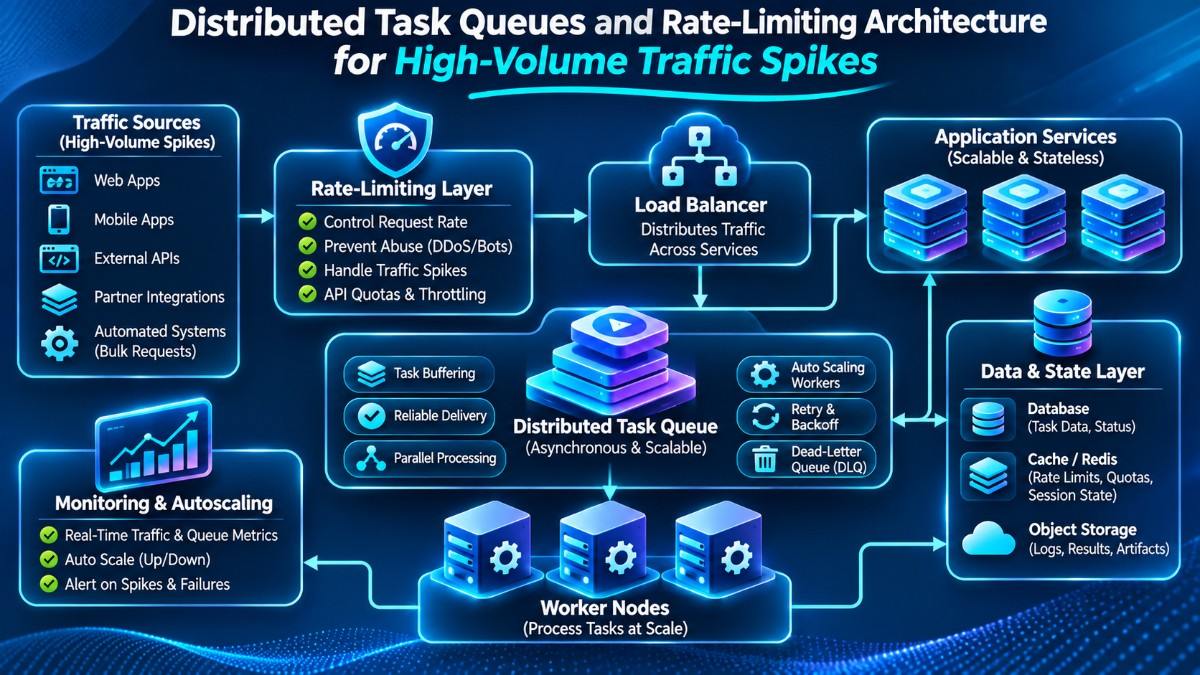
How do distributed task queues manage rate-limiting and thread allocation during sudden traffic spikes?
Distributed task queues are backend asynchronous processing mechanisms that temporarily buffer incoming requests in memory and dispatch them at a controlled rate to prevent downstream server crashes. By decoupling request ingestion from worker thread execution, message brokers absorb sudden traffic spikes while enforcing strict upstream rate-limiting thresholds.
When high-volume marketing agencies or automated reseller scripts trigger thousands of simultaneous API requests within a single second, synchronous web servers quickly exhaust available CPU cores and database connection pools. Without an intermediate buffering layer, unthrottled concurrency spikes lead to deadlocked database rows, dropped TCP sockets, and cascading HTTP 503 timeouts.
To guarantee uninterrupted order ingestion during peak load windows, enterprise architectures rely on in-memory message brokers paired with real-time automated system status monitoring. Instead of forcing the web server to execute heavy downstream tasks immediately, the ingestion gateway pushes validated payloads into a distributed ring buffer and returns an instant acknowledgement to the client.
What are the primary architectural components of an asynchronous distributed task queue?
A fault-tolerant distributed queuing pipeline coordinates four specialized subsystem components to balance high-speed ingestion with rate-limited execution:
- Component #1 — Non-Blocking Ingestion Producer (API Gateway): Validates the incoming JSON payload, assigns a monotonic task UUID, and serializes the job into the message broker in under 5 milliseconds without blocking HTTP worker threads.
- Component #2 — In-Memory Message Broker And Ring Buffer: Stores pending task payloads inside high-speed RAM clusters (such as Redis Streams or RabbitMQ exchanges) partitioned by priority tier and target endpoint category.
- Component #3 — Token-Bucket Rate Limiter Middleware: Regulates the exact number of tasks released from the queue per second, ensuring downstream execution nodes never exceed external platform rate limits or proxy subnet quotas.
- Component #4 — Horizontally Scaled Worker Thread Pools: Autonomous background daemon processes pull released jobs from the broker, execute the remote procedure call, and commit final completion states back to the primary database.
How does asynchronous queue buffering compare to synchronous direct execution under peak load?
Compare the resource utilization, failure recovery, and throughput telemetry between synchronous direct execution and distributed task queues below:
| Operational Metric | Synchronous Direct Execution | Distributed Task Queue Architecture |
|---|---|---|
| Traffic Spike Resilience | Crashes With HTTP 502/504 Under Bursts | Absorbs 10,000+ Queued Jobs Seamlessly |
| Worker Thread Allocation | 1:1 Thread Lock Until Downstream Replies | Dynamic Consumer Pool With Backpressure |
| Rate-Limit Compliance | Triggers Downstream IP Rate Bans | Precision Token-Bucket Pacing Per Node |
| Transient Fault Recovery | Permanent Task Loss On Network Blip | Automated Exponential Backoff & Dead-Letter Queue |
How do worker pools allocate threads and prevent deadlocks across multi-priority queues?
Follow this 3-step engineering workflow to see how backend supervisors schedule threads and maintain steady throughput across hundreds of service endpoints:
- Partition Incoming Workloads Into Isolated Priority Channels Rather than pushing every task into a single FIFO (First-In, First-Out) pipe where a massive bulk job could delay smaller requests, the router segregates instant high-priority tasks from gradual drip-feed schedules across our live service directory.
- Enforce Sliding-Window Rate Limits Before Worker Checkout Before a worker thread claims a task from the queue, a distributed Redis Lua script evaluates the current sliding-window counter for the target endpoint. If the node is at maximum concurrency capacity, the task remains safely buffered for the next millisecond tick.
- Recycle Stalled Threads Via Visibility Timeouts And Heartbeats Every active worker thread emits an automated heartbeat signal while processing a job. If a downstream network timeout causes a worker to hang beyond its visibility window, the supervisor reclaims the lock and re-queues the task to a healthy standby thread automatically.
Engineering Note: Implementing Exponential Backoff With Jitter
When a downstream cluster temporarily returns a rate-limit signal, retrying all queued tasks at the exact same fixed interval creates a "thundering herd" collision. Adding randomized millisecond jitter to an exponential backoff formula (delay = base * 2^attempt + random_jitter) smooths out retry waves and restores stable queue drainage.
Ready To Scale High-Volume Campaigns Without Bottlenecks?
Connect to our distributed queuing infrastructure for sub-second order ingestion and automated rate-limited fulfillment.
Launch Your Wholesale Account NowFrequently Asked Questions
What is the difference between a token-bucket algorithm and a leaky-bucket rate limiter?
A token-bucket algorithm permits short, controlled bursts of traffic up to the bucket capacity as long as tokens are available, whereas a leaky-bucket algorithm enforces a rigid, constant outflow rate regardless of incoming burst velocity.
How does a Dead-Letter Queue (DLQ) protect distributed task pipelines from poison messages?
If a malformed task repeatedly fails validation or exceeds its maximum retry threshold, the broker moves the job into an isolated Dead-Letter Queue for diagnostic inspection, preventing it from blocking healthy tasks behind it.
Why do high-concurrency systems decouple HTTP ingestion from database write commits?
Relational databases lock rows and index trees during concurrent write transactions. Buffering incoming writes inside an in-memory task queue allows the database to commit batched transactions sequentially without lock contention.

Luv Kalra
SEO Expert & Founder of iLuv SMM PanelWith 19+ years of technical SEO and digital marketing experience, Luv engineers high-concurrency API dispatch architectures and automated telemetry systems for enterprise agencies.