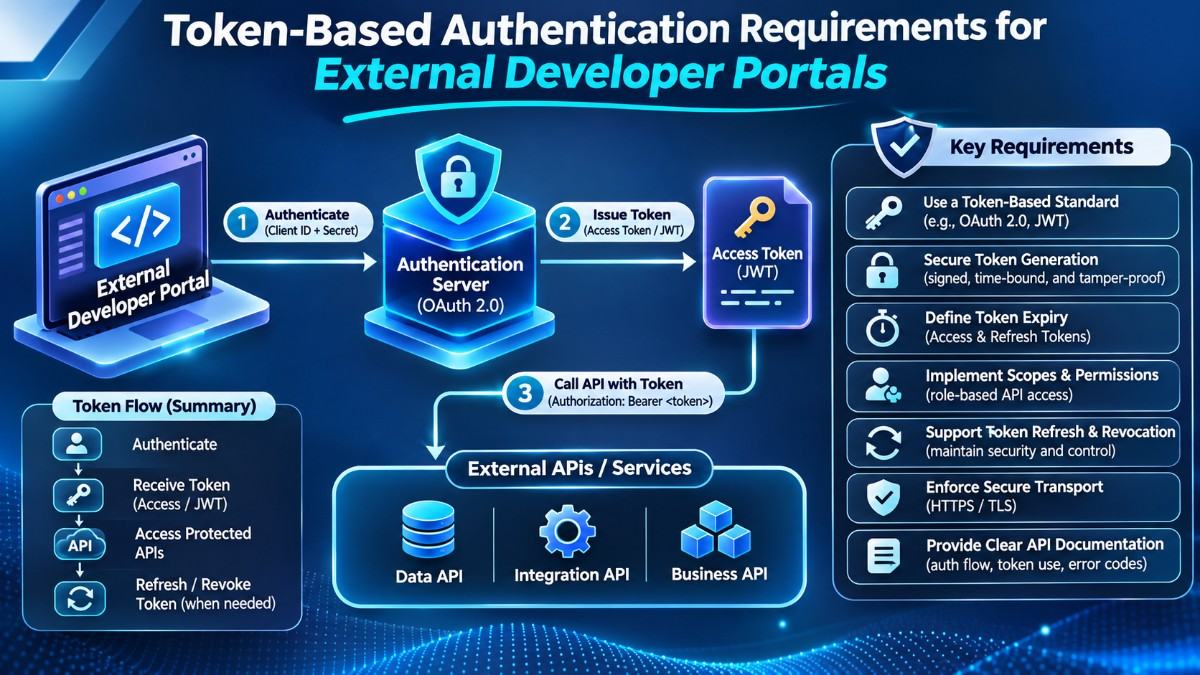
What are the precise security requirements for establishing token-based authentication in external developer portals?
Token-based authentication is a stateless security protocol that generates a unique cryptographic signature, allowing client applications to verify their identity on subsequent API requests without re-submitting raw credentials. Enforcing TLS 1.3 encryption, high-entropy key generation, and granular IP allowlisting prevents unauthorized payload interception across external developer portals.
When external software applications, automated reseller scripts, and enterprise CRMs communicate with backend fulfillment servers, transmitting static usernames and passwords inside every HTTP packet creates severe vulnerability vectors. If an unencrypted request log is exposed at an intermediate proxy hop, plain-text credentials can be harvested and replayed instantaneously.
To eliminate credential exposure and enforce strict zero-trust verification, engineering teams implement iLuvSMM developer security standards across all server-to-server connections. By replacing session cookies and raw login strings with revocable cryptographic API tokens, backend gateways authenticate high-frequency requests in microseconds while keeping core account privileges isolated.
Which cryptographic controls protect bearer tokens against unauthorized interception and replay attacks?
Securing an external developer portal requires implementing four mandatory cryptographic and transport-layer controls across every API endpoint:
- Control #1 — High-Entropy Cryptographic Key Generation (CSPRNG): API tokens must be generated using a cryptographically secure pseudorandom number generator with at least 256 bits of entropy, rendering brute-force dictionary guessing mathematically infeasible.
- Control #2 — Mandatory TLS 1.3 Transport Layer Encryption: All incoming API calls must traverse HTTPS endpoints configured with TLS 1.3 cipher suites, ensuring bearer tokens inside HTTP authorization headers or POST payloads cannot be sniffed in transit.
- Control #3 — At-Rest SHA-256 Token Hashing In Databases: Production databases should store only the salted cryptographic hash of an API key rather than the plain-text string, preventing key leakage even during internal database audits.
- Control #4 — Scoped Permission Boundaries And IP Allowlisting: Tokens must be restricted solely to programmatic order placement, status polling, and balance queries—never granting administrative password changes or withdrawal privileges without secondary verification.
How does stateless token authentication compare to legacy session-cookie authentication in APIs?
Examine the architectural security comparison below to understand why modern developer portals mandate stateless bearer tokens over stateful browser sessions:
| Security Dimension | Legacy Stateful Session Cookies | Stateless Token-Based Authentication |
|---|---|---|
| Server Memory Overhead | High (Requires Sticky Session Storage) | Zero Session State (Instant Hash Lookup) |
| CSRF Attack Surface | Vulnerable To Cross-Site Request Forgery | Immune (Explicit Header / Payload Token) |
| Revocation Granularity | Requires Full Account Password Reset | Instant Single-Click Token Rotation |
| Cross-Domain S2S Support | Blocked By Browser SameSite Policies | Native Multi-Region Server Compatibility |
How should developers store, transmit, and rotate API keys across production environments?
Follow this 3-step operational security workflow to integrate external API keys without exposing credentials in source code repositories:
-
Isolate API Tokens Inside Encrypted Server Environment Variables
Never hardcode your API key directly inside public GitHub repositories, client-side JavaScript files, or mobile app binaries. Load the secret string dynamically from a server-side
.envvault or cloud secrets manager at runtime. - Authenticate Requests Via Encrypted HTTPS POST Payloads Pass your token inside the encrypted request body or authorization header rather than appending it to plain-text URL query strings (which get recorded in proxy access logs). Review exact parameter syntax inside our developer API documentation.
- Execute Scheduled 90-Day Key Rotation And Anomaly Audits Regenerate your production API token every 90 days—or immediately whenever a developer leaves your team—and update your backend environment variable to invalidate legacy keys instantly.
Security Best Practice: Never Expose Backend API Keys In Frontend Browser Code
If you are building a custom client storefront, never invoke the upstream provider API directly from browser-side React or jQuery scripts where users can inspect the Network tab. Always route client requests through your own backend middleware proxy so your master API token remains 100% hidden on your server.
Ready To Deploy Secure Token-Authenticated Fulfillment?
Generate your high-entropy API key in seconds and automate server-to-server order processing over TLS 1.3.
Access Your Developer Portal NowFrequently Asked Questions
Why should API authentication tokens never be passed inside URL query parameters?
Passing secret tokens inside URL query strings exposes the credential in plain text within browser histories, corporate proxy logs, CDN access records, and HTTP Referer headers. Transmitting tokens inside an encrypted HTTPS POST body or Authorization header keeps the credential hidden from intermediate network logs.
What happens to active orders when a developer rotates or regenerates an API key?
Rotating an API key immediately invalidates the old cryptographic string for future incoming requests, but all previously accepted orders already inside the backend execution queue continue processing normally to completion without interruption.
How does constant-time string comparison prevent timing attacks during token verification?
Standard byte-by-byte string comparisons return false as soon as the first mismatched character is found, allowing attackers to measure microsecond response differences. Constant-time comparison algorithms evaluate the entire hash length uniformly, eliminating timing side-channel leaks.

Luv Kalra
SEO Expert & Founder of iLuv SMM PanelWith 19+ years of technical SEO and digital marketing experience, Luv engineers high-concurrency API dispatch architectures and automated telemetry systems for enterprise agencies.